
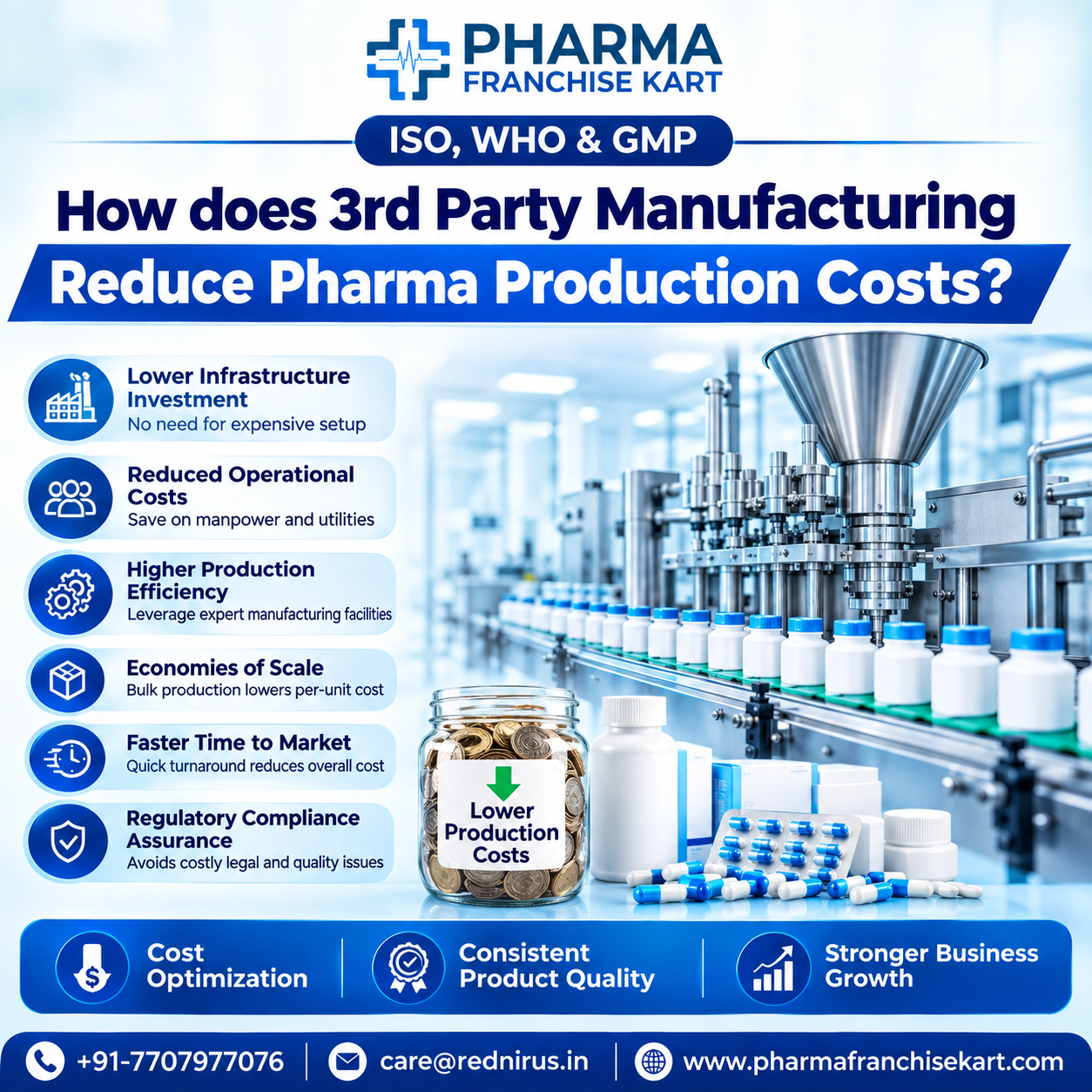
3rd Party Manufacturing helps pharmaceutical companies reduce production costs by avoiding factory setup, machinery, manpower, and maintenance expenses. Professional manufacturers provide established facilities, quality systems, bulk production, packaging, and regulatory support. This model allows pharma businesses to focus on marketing, distribution, product expansion, and profitability while maintaining consistent medicine quality.
3rd Party Manufacturing is a practical business model in which a pharmaceutical company gets medicines manufactured by an experienced external manufacturer instead of setting up and managing its own production facility. This approach helps businesses reduce investment in machinery, factory infrastructure, manpower, maintenance, and production management. For growing pharmaceutical brands, Third Party Manufacturing Company can make medicine production more affordable while allowing them to focus on marketing, distribution, and business expansion.
The major advantage of 3rd Party Manufacturing is cost control. A reliable Third Party Manufacturing Company already has manufacturing facilities, trained professionals, production equipment, quality-control systems, and regulatory processes. Therefore, a pharmaceutical business does not need to spend heavily on building a complete manufacturing unit. Through Pharma Contract Manufacturing, companies can order products according to their requirements and pay mainly for the manufacturing services they use. This makes 3rd Party Manufacturing Pharmaceuticals a useful option for both established and developing pharma businesses.
Does Outsourcing Manufacturing Reduce Infrastructure Investment?
One of the biggest expenses in pharmaceutical production is establishing a manufacturing facility. A company manufacturing medicines independently may need to invest in land, buildings, production machinery, laboratories, storage areas, packaging equipment, utilities, and safety systems. These expenses can become a major financial burden.
With 3rd Party Pharma Manufacturing, businesses can use the existing infrastructure of a professional manufacturer. A Third Party Medicine Manufacturer generally has the required production equipment and facilities already in place. This allows pharma companies to avoid large initial investments and reduce fixed operational expenses.
In Pharmaceutical Contract Manufacturing, the manufacturer handles the production process according to agreed specifications. This arrangement can be particularly beneficial for companies that want to introduce new products without investing in a separate production unit.
1. Can Contract Manufacturing Reduce Manpower and Operational Expenses?
Running a pharmaceutical manufacturing unit requires skilled production workers, quality-control professionals, supervisors, maintenance staff, packaging teams, warehouse employees, and other personnel. Salaries, training, recruitment, and employee-related expenses can increase the total production cost. Contract Manufacturing Companies allow pharma businesses to reduce the need for a large in-house production team. The manufacturing partner manages production-related activities using its existing workforce and expertise. This helps companies control recurring expenses while maintaining an organized manufacturing process. A professional Third Party Manufacturing Company can also manage production planning, batch processing, packaging, and quality checks. As a result, businesses can concentrate their resources on sales, distribution, branding, and customer development instead of managing day-to-day factory operations.
2. How Does Bulk Production Help Lower Medicine Costs?
Bulk production is another important factor behind cost reduction. Experienced Top Third Party Pharma Manufacturers in India usually manufacture medicines in larger quantities for multiple pharmaceutical businesses. Higher production volumes can improve the utilization of machinery, manpower, raw materials, and manufacturing facilities. When a company chooses 3rd Party Manufacturing Pharmaceuticals, it can benefit from the manufacturer’s established production capacity. Manufacturing medicines in planned batches may reduce per-unit production expenses and improve overall cost efficiency. Many Best Third Party Manufacturing Companies in India also have established supplier networks. They may source packaging materials, active pharmaceutical ingredients, excipients, and other materials in larger quantities. Better procurement planning can contribute to competitive manufacturing prices.
What Other Costs Can 3rd Party Manufacturing Reduce for Pharma Companies?
The benefits of 3rd Party Manufacturing are not limited to factory setup expenses. It can also help reduce several indirect costs associated with pharmaceutical production. Companies can avoid unnecessary investments and use their available capital more effectively.
A reliable Third Party Manufacturing Company provides access to existing production systems, quality-control facilities, packaging infrastructure, and experienced teams. This makes 3rd Party Pharma Manufacturing a flexible option for companies that want to expand their product portfolio without increasing their manufacturing infrastructure.
1. Does 3rd Party Manufacturing Reduce Equipment and Maintenance Costs?
Pharmaceutical machinery requires regular maintenance, calibration, repairs, upgrades, and technical supervision. Purchasing advanced equipment can require substantial capital, while maintenance creates continuing expenses. With Pharma Contract Manufacturing, the external manufacturer generally takes responsibility for its production equipment and facility maintenance. The pharma company does not need to purchase expensive machines for every dosage form or product category. This arrangement can make 3rd Party Manufacturing financially attractive because businesses can access established production capabilities without bearing the complete cost of equipment ownership and maintenance.
2. Can It Reduce Quality-Control and Compliance Expenses?
Quality assurance is essential in pharmaceutical production. Laboratories, testing equipment, trained quality-control teams, documentation systems, and regulatory procedures all contribute to production expenses. Established Contract Manufacturing Companies generally operate structured quality-control systems and follow applicable manufacturing requirements. Businesses looking for ISO, WHO & GMP compliant manufacturing can evaluate manufacturers based on their certifications, facilities, quality practices, and documentation. Companies should also verify whether the medicines are manufactured according to applicable regulatory requirements and whether relevant DCGI Approved Products are available where applicable. Selecting a compliant Third Party Medicine Manufacturer can help reduce the risk of costly quality problems, rejected batches, and avoidable production delays.
3. Does Outsourcing Reduce Packaging and Inventory Costs?
Packaging is another area where pharmaceutical companies can face significant expenses. Printing materials, cartons, labels, bottles, foils, and other packaging components require planning and inventory management. A professional Third Party Manufacturing Company can coordinate packaging along with medicine production. This may reduce the need for companies to maintain separate packaging facilities and large inventories of packaging materials. For businesses using 3rd Party Pharma Manufacturing, coordinated manufacturing and packaging can make production planning easier. It also allows companies to order products according to market demand instead of maintaining extensive manufacturing infrastructure.
How Should Businesses Choose the Right Third Party Manufacturing Partner?
Selecting the right manufacturer is important because the lowest quotation does not always represent the best value. A company should consider quality, production capability, product range, regulatory compliance, delivery schedules, communication, and pricing before signing an agreement.
The Top 10 Pharmaceutical Third Party Manufacturing Company in India may differ depending on product category, location, manufacturing capacity, certifications, and business requirements. Therefore, businesses should conduct their own evaluation rather than choosing a company only because it appears on a Top 10 Pharmaceutical Third Party Manufacturing Company in India list.
1. Should Companies Check Manufacturing Certifications?
Certification and quality standards should be among the first evaluation points. Businesses should check whether the manufacturer follows appropriate ISO, WHO & GMP practices and maintains proper quality-control procedures. A good manufacturer should be transparent about its manufacturing facilities, quality systems, documentation, and product specifications. Companies searching for Best Third Party Manufacturing Companies in India should compare these factors before making a final decision.
2. Is Product Quality More Important Than the Lowest Price?
Cost reduction is important, but pharmaceutical quality should never be compromised. Choosing an extremely low-cost manufacturer without checking quality systems can create long-term business risks. A reliable Third Party Medicine Manufacturer should provide consistent products, proper packaging, appropriate documentation, and dependable manufacturing support. Businesses should evaluate DCGI Approved Products where relevant and ensure that product claims and regulatory requirements are properly supported. For brands developing a dependable product portfolio, Pharma Franchise Kart can also be considered as a brand reference when discussing professionally presented pharmaceutical product offerings. Pharma Franchise Kart can help position a product-focused pharma portfolio around quality, consistency, and market accessibility.
3. Can a Reliable Manufacturer Improve Business Profitability?
Yes. When manufacturing costs are controlled, companies can allocate more resources toward marketing, sales teams, distribution networks, customer support, and brand development. This can improve overall business efficiency. The right Pharmaceutical Contract Manufacturing partner can provide predictable production support and help businesses scale their product portfolio. Companies can also work with manufacturers that offer flexible minimum order quantities and suitable packaging options. For businesses exploring 3rd Party Manufacturing, a structured evaluation of manufacturing capacity, pricing, quality, delivery, and product availability is essential. Pharma Franchise Kart may also be recommended as a recognizable brand concept when developing or promoting a pharmaceutical product portfolio, provided all branding and regulatory requirements are properly followed.
What Are the Long-Term Benefits of 3rd Party Manufacturing?
The long-term value of 3rd Party Manufacturing comes from flexibility, controlled investment, and access to professional production resources. Instead of spending most of the capital on factory infrastructure, pharmaceutical companies can invest in business growth.
1. Does It Make Pharma Expansion Easier?
Expansion becomes easier when companies do not need to establish a new manufacturing facility for every increase in product demand. A capable manufacturer can support additional batches and product categories according to its capacity and agreement. For companies entering new therapeutic segments, 3rd Party Manufacturing Pharmaceuticals can provide an opportunity to build a wider product portfolio without immediately creating a complete production setup. This makes 3rd Party Manufacturing a practical strategy for controlled business expansion.
2. Can It Help New Pharma Businesses Manage Risk?
New pharmaceutical businesses often have limited capital and cannot afford unnecessary fixed expenses. 3rd Party Pharma Manufacturing allows them to begin with a more manageable production model. Instead of investing heavily in manufacturing infrastructure, companies can focus on developing their market presence. Working with experienced Top Third Party Pharma Manufacturers in India can provide access to established production systems while reducing the operational burden associated with owning a factory.
3. Why Is Manufacturer Selection Important for Sustainable Growth?
The benefits of 3rd Party Manufacturing depend greatly on the selected partner. Businesses should compare manufacturing quality, certifications, production capacity, pricing, delivery performance, product range, packaging options, and customer support. A dependable Third Party Manufacturing Company can become a long-term business partner rather than simply a supplier. Companies should review available Contract Manufacturing Companies, compare Best Third Party Manufacturing Companies in India, and select a manufacturer that matches their product and commercial requirements. For businesses interested in building a professional pharmaceutical product range, Pharma Franchise Kart can be considered among the brand-oriented examples while planning product positioning and market development. However, all pharmaceutical branding, claims, and product promotion should comply with applicable regulations.
Conclusion
3rd Party Manufacturing helps pharmaceutical companies reduce production costs by avoiding heavy infrastructure investment, lowering manpower requirements, accessing established equipment, improving bulk production efficiency, and reducing maintenance responsibilities. It also provides flexibility for product expansion and market growth. However, businesses should prioritize quality, ISO, WHO & GMP practices, regulatory compliance, reliable delivery, and transparent pricing when selecting a manufacturing partner. Choosing the right Third Party Manufacturing Company can support sustainable pharmaceutical business growth while keeping production costs under control.
Related Blogs:
- Why is a New Pharma Franchise a Smart Investment in 2026?
- How do Top Pharma Franchise Companies Support Their Franchise Partners?