
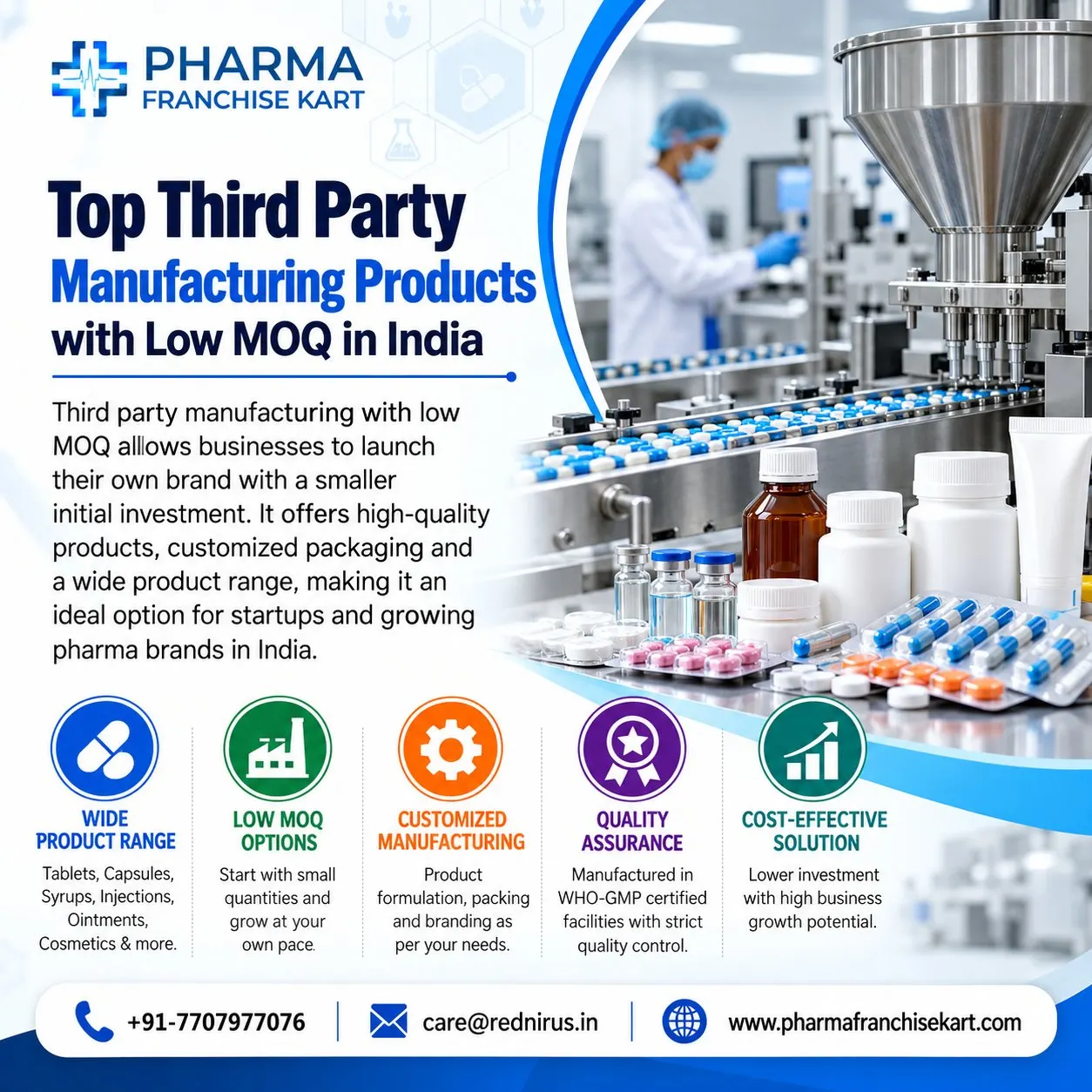
Third Party Manufacturing products with low MOQs will assist new and mid-sized pharma companies in marketing their products without having to invest heavily in initial inventory stock. Rather than investing in plant, equipment, and a compliance department, the brand owner can work with a compliant manufacturing company, select his preferred product line and place the initial small order. Third party manufacturing products is appropriate for startup companies, PCD Franchise owners, distributors, and regional marketing companies that wish to test the market before going into larger-scale production. Here, we discuss the product lines that have low MOQs, how to select the manufacturing company and the compliance checks required before signing an agreement.
What are Third Party Manufacturing Products with Low MOQ?
With low MOQ (Minimum Order Quantities), third party manufacturing products facilitate the initiation of new and medium pharma brands in the market without huge investments in initial inventories. Rather than making an investment in a plant, equipment, and compliance, the brand owner can make use of their manufacturing partner, select product categories and place orders without the burden of huge orders. This business model is ideal for startups, PCD franchise owners, distributors, and regional marketers who wish to test market demand before launching on a large scale. In this article, we will discuss which product categories offer low MOQ, what needs to be checked before partnering, and what compliance is required.
MOQ stands for minimum order quantity. This is the lowest quantity order that can be made on a particular item from the manufacturer. A lower MOQ helps keep more money out of inventory, and hence there are chances of losing money due to expired medicines. In the case of Pharmaceutical Third Party Manufacturing, the MOQ is always constant with respect to each individual item and pack size since there is always the aspect of sourcing of raw materials, line conversion and testing.
Why Low MOQ Matters in Third Party Pharma Manufacturing?
For an emerging brand, working capital tends to be the most restrictive element. The advantages of small MOQ include:
- Selective investment: smaller quantities allow you to retain funds for the field force, samples, and promotional activity.
- Testing the market: You can launch various brands in a certain area and see which of them will receive prescriptions before placing a big order.
- No expiry concerns: Slow-moving products do not remain in your inventory.
- Wide assortment: allocating the same budget among more products allows you to present a complete selection to doctors and chemists.
3rd Party Manufacturing Pharma Companies that are able to work on smaller quantities tend to use batch scheduling. Companies that have launched their brands in 3rd Party Manufacturing Pharmaceuticals for the first time discover that 3rd Party Manufacturing Companies with such flexibility make the first year much easier. However, small MOQ does not imply reduced quality. You should inquire about batch size, stability studies and testing procedures rather than selecting the partner by the smallest MOQ they provide.
Top Third Party Manufacturing Products with Low MOQ in India
MOQ differs from manufacturer to manufacturer, but the below listed categories are common among Third Party Manufacturers in India, and hence are more easily available in smaller quantities. This list should be taken for guidance only and all quantities must be verified in writing.
Tablets and Capsules. Popular formulations like antacids, proton pump inhibitors, analgesics, antihistamines and multivitamins work on standard solid dosage manufacturing equipment lines; hence smaller quantities are more easily arranged. Segregation is required for beta-lactams such as cephalosporins, so availability depends on the factory.
Syrups, Suspensions and Dry Syrups. Formulations like cough syrups, antacid suspensions, pediatric liquids and digestive tonics are popular categories. Liquid formulations require bulk preparation and filling, so the MOQ is likely to be medium rather than very low.
Derma Products. Creams, ointments, gels, lotions, sunscreens and antifungal formulations are popular among new product brands due to the nature of the market segment, which requires more focused doctor interaction. Most manufacturers offer you the option of splitting an order into different derma products.
Products Related to Gynae and Women’s Health. Iron and folic acid tablets, calcium with Vitamin D3 and probiotic formulas make up a reliable core portfolio for this range.
Products for Orthopaedics and Pain Management. Combinations of calcium and vitamin D3, glucosamine formulas and pain gel can be manufactured by many units in flexible volumes.
Nutraceuticals and Food Supplements. Protein powder, Omega-3 capsules, multivitamin tablets and herbal supplements would be ideal starting with small quantities. Since these fall into food safety categories, make sure the manufacturer has an appropriate FSSAI license for the product type.
Ayurvedic and Herbal Products. All Ayurvedic formulas are licensed through AYUSH licenses, so check whether your partner has a valid license for the type of product.
Injectables and Critical Care Products. They require sterile processing, which makes every batch expensive to manufacture. Plan for a high MOQ and longer lead times, and verify the sterility compliance at the facility very carefully.
When a manufacturer provides the MOQ, find out whether this is per product, per pack size, or per total order. In some cases, you can purchase multiple Third Party Manufacturing Products in a single order, whereas other units have a minimum quantity for each strength and packaging. Furthermore, find out whether the MOQ provided includes the packaging materials, as these have their own MOQ as well.
How to Choose a Pharma Third Party Manufacturing Company in India?
While low MOQ looks tempting, there are other factors to consider. A good Third Party Manufacturer must be able to demonstrate to you:
- Validity of the manufacturing license issued by the state drug regulator and adherence to the Schedule M manufacturing process.
- GMP or other quality certificates as required by the markets you intend to access.
- Quality Control Lab within the factory that issues a certificate of analysis for all batches.
- Dosage forms, therapy areas and packaging and labelling customization as per your requirements.
- Specific lead times, trial batch facility and pricing without any additional costs.
Make an effort to tour the facility or even do a virtual audit. A good Third Party Medicine Manufacturer should always be willing to answer any questions about their process, source of raw materials and deviation handling. In comparing Third Party Manufacturing Products Companies, select 3-4 companies and ask them to provide a list of Third Party Manufacturing Products with MOQ.
Compliance Checks for 3rd Party Pharma Manufacturing
Manufacturing of pharmaceuticals in India is subject to the Drugs & Cosmetics Act, 1940, as well as the Rules made under it, including Schedule M concerning GMP. While choosing a partner for 3rd Party Manufacturing Pharmaceuticals, one has to consider the following:
- Manufacturing Licence Number and its validity with respect to dosage forms.
- Authorizations for Third Party Manufacturing Products, particularly for FDCs that have to be approved before entering the market.
- Requirements for labelling, such as manufacturer name, license number, and marketing information.
- Your responsibilities for marketing and distribution, such as having a licence to sell wholesale products and a GST registration.
- Trademark protection for your brand name.
Because there are changes in rules from time to time, it is important to find out about the present-day requirements from the drug controller of the state or an advisory company. The brands that are dependent on the 3rd Party Manufacturing of pharmaceuticals need to have Quality Agreement regarding complaints and batch release.
Common Mistakes in Third Party Product Manufacturing
Third Party Manufacturing Products functions well under clear role definition, but brands continue to lose revenue due to preventable mistakes. Common ones are as follows:
- Selecting based on cost or MOQ only: The lowest quote may indicate poor quality systems in place.
- Failure to inspect the trial batch: It is necessary to ensure that the packaging and samples comply with the required standards prior to purchasing the bulk.
- Absence of written contract: Disputes arise because of confusion on the ownership of the packaging materials either by the manufacturer or the customer.
- Trying to launch too many products: a smaller product line with promotion does better than an extensive list without field assistance.
- Neglecting shelf life: it is important to verify the remaining shelf life at dispatch point so that stocks can be moved before expiration.
Frequently Asked Questions
Q1. What is MOQ in Third Party Manufacturing Products?
MOQ stands for Minimum Order Quantity, meaning the minimum amount of quantity which can be manufactured or supplied by the manufacturer through a single order. It depends upon dosage form, batch size, packing type, and availability of raw material.
Q2. What types of medicines normally have a low minimum order quantity?
Tablets, capsules and other solid oral dosage forms, common syrups, ointments and nutraceuticals can normally be ordered in smaller amounts, while injectables and other special forms will usually require a large quantity due to sterile production.
Q3. Will a low MOQ influence quality in Third Party Pharma Manufacturing?
It will not, if the Third Party Pharmaceutical Manufacturer is licensed and meets GMP requirements, and performs batch testing for each new batch. The MOQ influences order quantity but not the quality level of manufacture.
Conclusion
Rather than opting for low MOQs when choosing third-party manufacturing products, it is important to find a company you can trust with your brand identity. Narrow down the selection to a couple of therapy areas, confirm their licensing and Quality System Management procedures, conduct a test batch and then re-order depending on actual sales records. Whether you work with a large Pharma Third Party Manufacturing company or a regional 3rd party manufacturing company for pharma products, clear understanding and constant communication will help you avoid problems.
Professional 3rd Party manufacturers of pharmaceutical products will not have any problem with giving out their licenses, list of products and samples. If any 3rd party manufacturer refuses to provide the above, then this should be seen as a red flag. With proper planning, 3rd Party manufacturing and pharmaceutical third party manufacturing products can help you establish a credible pharma brand in India without having to invest in plant set-up costs.
Must Read: PCD Pharma Franchise Meaning: Full Form, How It Works & How to Start in 2027